Interesting facts on the Raj Ghat in New Delhi
This week let’s check out an important political centre, though a lesser known tourist place, in New Delhi namely the Raj Ghat.
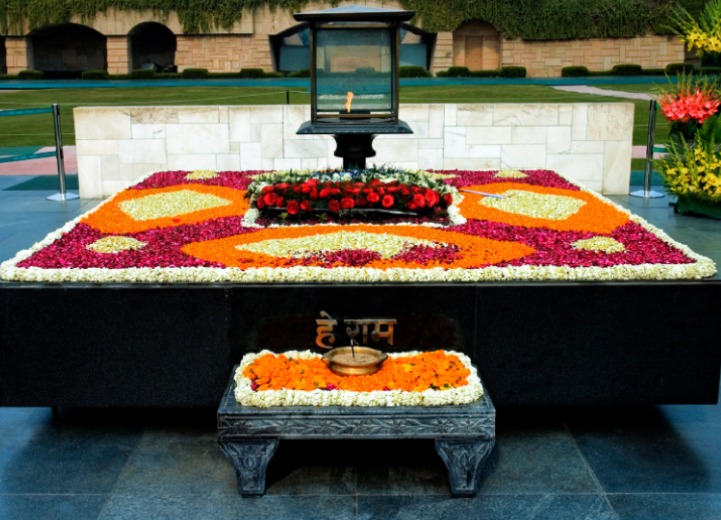
- The Raj Ghat, which is located on the Delhi’s Ring Road, carries a lot of political significance as it is the memorial dedicated to Mahatma Gandhi.
- This is the very site, a shiningly black marble platform, where Gandhiji is cremated. It is an open to the sky platform.
- There is an external flame placed at one end of the platform. The Delhi’s Ring Road is also popularly called the Mahatma Gandhi Road.
- The site features a stoned footpath and on either sides, there are lawns. This footpath takes you to the memorial.
- In addition to the Raj Bhat, you can add several places such as the India Gate, the Lotus Temple, the Red Fort, et al to the bucketlist of tourist destinations in New Delhi.
- The best time to visit the Raj Ghat is during the winter months, as the summers are generally hot and humid in the capital.
- The natural milieu of the Raj Ghat area is also filled with trees planted by public figures and other distinguished personalities.
- Mahatma Gandhi when assassinated on 30th January 1948 was cremated at this place. Previously known as Shajahanabad, a big Ghat of Old Delhi, the memorial was later renamed as the Raj Ghat.
- The Raj Ghat is also resting place of several other leaders including that of Jawaharlal Nehru known as the Shantivan, located to the north of the Raj Ghat, and situated close to it is the cremation site of K R Narayan, the 10th president of India, called Ekta Sthal.
- Alick Percy-Lancaster, who was the Superintendent of Horticultural Operations, GOI, undertook the landscaping of the area. Interestingly, he was the last Britisher to occupy this post.
All about the famous Diwan-i-Khas in Fatehpur Sikri
- Diwan-i-Khas, or more popularly known as the Hall of Private Audience, is located in the northeast corner of the royal complex, constructed with a massive and splendidly carved pillar in the centre.
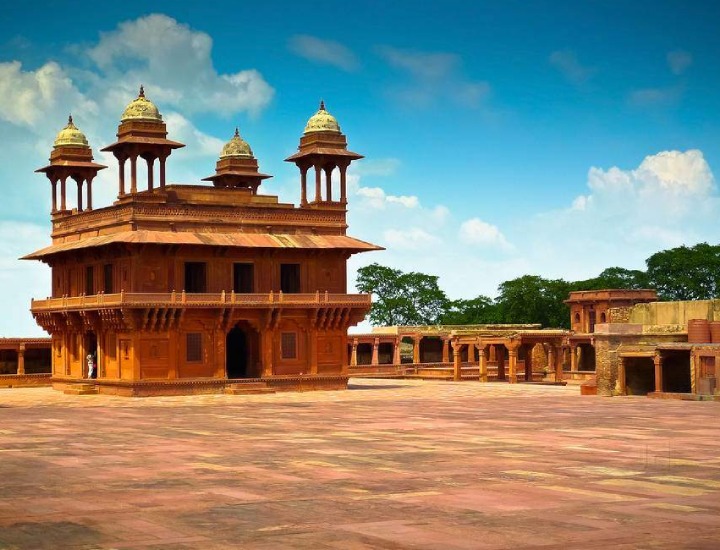
- There is a central platform that is attached to the pillar. This is believed by many to be the seat of the powerful Mughal emperor with the diagonal galleries the seat of the nobles and ministers entertained in the court.
- However, there are others who believed that because the galleries were too narrow to house all the courtesans and ministers at once, the building actually served as the storehouse for the valuable treasures of the royalty including gems and jewels that were inspected by the Emperor himself.
- According to the historian Abul Fazl, the Mughal ruler Akbar had three treasuries located close to each other and only one among them was used to store the priceless possessions.
- As this building is nearby the ‘Ankh Michauli’ or the storehouse of gold and silver, it is widely believed to be the treasury for jewels.
- There are four double-storeyed facades in this square red sand stone structure. You will find no huge dome or superstructure here typical of Islamic architecture but four impressive kiosks at every corner of the building that are octagonal-shaped, crowned by a circular dome with an inverted lotus mounted on the top elevating the overall height of the structure.
- The interior arrangements are unique in design. The main hall comprises an elegantly designed capital constructed by linking 36 brackets emerging from the pillars in three tiers that are circularly shaped. The building isn’t known for ornamentation unlike other Islamic architecture around the world. However, the imposing situated in the centre is definitely one of the towering examples of the Mughal architecture.