
All about the Ambalapuzha Sree Krishna Temple in Alleppey
- The Ambalapuzha Sree Krishna Temple is a Hindu Temple believed to have been constructed by the local ruler Chembakassery Pooradam Thirunal-Devanarayanan Thampuran (Alleppey) between the 15th and 17th centuries AD in Alappuzha (Alleppey).

- The temple is linked to the famous Sri Krishna Temple in Guruvayoor. The idol of the temple is held sacred on a par with Parthasarthi that is posing with a whip in the right hand and a sacred Shanku (conch) in the other hand.
- The Palpayasa Nedyam or Payasam, in the form of a sweet pudding prepared of rice and milk, served in this temple is delectable and highly popular amongst devotees. Legend has it that Lord Guruvayoorappan himself visits this temple everyday to have Payasam.
- It is widely believed by the locals that Lord Krishna showed up in the form of a sage and played chess with the king, a chess enthusiast, who ruled that time. The king was challenged by the sage to offer him a grain of rice if he emerges victorious, with the condition that each square would double the grain of rice. The king having lost the game was happy to donate the grain of rice but he soon realized this vicious game of doubling the grain of rice on each square as he ran short of the food grain stock. However Lord Krishna, benevolent in his name, grants him a favour to pay him in part and serve paal payasam until and unless he clears his debt.
- Adopting Kerala style architecture, the temple boasts of a splendid construction displaying a beautiful painting of different avatars of Lord Vishnu in its premises, a centre-piece of attraction.
- Most of all, Ambalapuzha Sri Krishna Temple is notoriously famous for its magical acts and the annual Ottanthullal ritual.
- The main festival of this shrine is Chambakulam Moolam celebrated on the Moolam Day every year. This place is always buzzing with pilgrims and tourists to receive the blessings from Lord Krishna. The popular Aaraattu festival during the months of March and April begins with the flag hoisting on the Atham star. Pallipana is celebrated in the temple once in every 12 years.
All about the Albert Hall Museum in Jaipur
- The beauty of Jaipur in Rajasthan, as a tourist destination, is simply unrivalled. The best way to study the culture of a region is to visit the local museum. The Albert Hall Museum in Jaipur serves as the gateway to learning the cultural traditions and various art forms of the “Pink city”.

- Built in 1876, first as a concert hall and later as Town hall in 1880, the Albert Hall got its name from London’s Victoria and Albert Museum because of its strikingly similar architecture. The building’s foundation was laid out in 1876, when the Prince of Wales visited the city.
- It was Maharaja Sawai Madho Singh II, the ruler of Jaipur, who suggested that Albert Hall be used as a museum for industrial arts.
- The hall was later used for exhibiting masterpieces of local craftsmen and artisans. The museum, by 1881, was opened to public that even bought artwork, handicrafts and other masterpieces on display. However, the museum wasn’t fully constructed until 1887. Later, valuable antiques were added to the modern artefacts collection.
- The architecture of the building is Indo-Saracenic in style and holds unique stone ornamentation. The museum’s corridors stock Persian paintings, mural paintings, among others. The murals on view vividly express the ancient civilizations of Babylonians, Chinese, Greek and others.
- The museum houses 16 galleries in total that display a spectacular collection of antiques, artefacts and artworks in the following categories: Arms & Armour, Pottery, Sculptures, Miniature Paintings, Clay Works, Marble Art, International Art, Ivory, Jewellery, Woodwork & Furniture, Coins, Musical Instruments, Garments, Carpet, and other miscellaneous collections. In addition to these, there is an exclusive ‘gallery of the month’ which displays unique collections.
- The museum, which is open from 9AM to 5PM on all days, is well connected with all the other parts of the city. Located nearby the Merta Road Junction Railway Station, the Albert Hall Museum can be reached via local train, cab or public transportation.
All about the famous Diwan-i-Khas in Fatehpur Sikri
- Diwan-i-Khas, or more popularly known as the Hall of Private Audience, is located in the northeast corner of the royal complex, constructed with a massive and splendidly carved pillar in the centre.
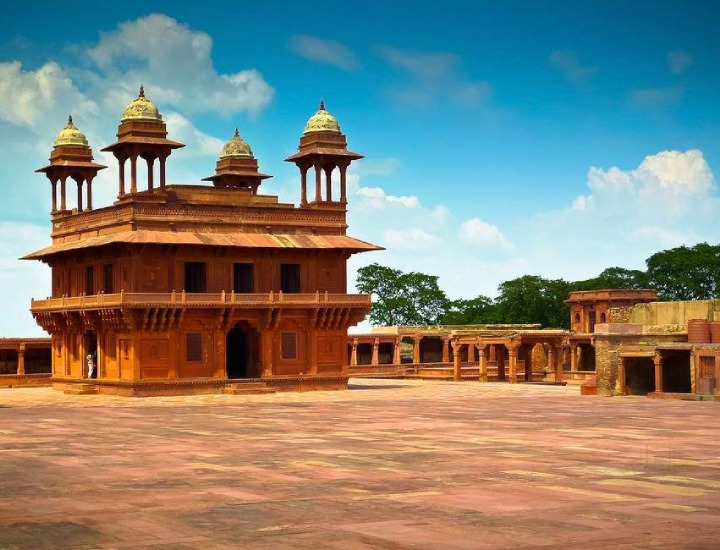
- There is a central platform that is attached to the pillar. This is believed by many to be the seat of the powerful Mughal emperor with the diagonal galleries the seat of the nobles and ministers entertained in the court.
- However, there are others who believed that because the galleries were too narrow to house all the courtesans and ministers at once, the building actually served as the storehouse for the valuable treasures of the royalty including gems and jewels that were inspected by the Emperor himself.
- According to the historian Abul Fazl, the Mughal ruler Akbar had three treasuries located close to each other and only one among them was used to store the priceless possessions.
- As this building is nearby the ‘Ankh Michauli’ or the storehouse of gold and silver, it is widely believed to be the treasury for jewels.
- There are four double-storeyed facades in this square red sand stone structure. You will find no huge dome or superstructure here typical of Islamic architecture but four impressive kiosks at every corner of the building that are octagonal-shaped, crowned by a circular dome with an inverted lotus mounted on the top elevating the overall height of the structure.
- The interior arrangements are unique in design. The main hall comprises an elegantly designed capital constructed by linking 36 brackets emerging from the pillars in three tiers that are circularly shaped. The building isn’t known for ornamentation unlike other Islamic architecture around the world. However, the imposing situated in the centre is definitely one of the towering examples of the Mughal architecture.
All about the Itimad-ud-Daulah Tomb – The Baby Taj Mahal in Agra
- The Itimad-ud-Daulah Tomb in Agra is also known as the ‘Baby Taj Mahal’, a precursor to the Taj Mahal. It was constructed by Noor Jahan for her father Mirza Ghiyaz Beg or Itimad-Ud-Daulah or ‘the pillar of the state’.

- Built in the years 1662-1628, five years before Taj Mahal was built, it is worth a visit when you are done visiting the iconic structure of the Taj in Agra.
- The extensive use of intricate inlays and white marbles makes it unique in terms of design and architecture, although it’s smaller in size compared to the Taj.
- Many historians believe that Emperor Shahjahan wanted to build something more significant and on a much grander scale than the Itimad-ud-Daulah Tomb, and thus built the Taj Mahal later.
- It is also believed a family feud led to the building of Taj Mahal which actually overshadowed the splendour and grandeur of the ‘baby’ Taj Mahal.
- The inside of the Itimad-ud-Daulah Tomb was kept relative simple without any superfluous embellishment or ornate decorations in line with the principles of the religion of Islam.
- There are fake tombs or cenotaph above the ground that are partially decorated and on display for visitors. In comparison to the exterior decoration, the interiors are neither dour nor flamboyant but stick to the principles of simplicity.
- There are inlays and geometric patterns at every turn. The linings of the walls in every chamber and corridor are filled with colorful paintings.
- The Baby Taj is open on all days. Security is pretty much tight here. Food, large bags, water, drinks, video camera and other electronic gadget except a camera are strictly disallowed.
A walk down the Zurich’s Old Town for world famous Swiss Chocolate & Sweets
Do you have a sweet tooth or a penchant for having nothing short of the best chocolates in the world? Make no mistake. The Swiss-made chocolates are simply unrivaled ever since chocolates became commercially available. But do you know of the quaint small town that makes these world-famous chocolates? The town of Zurich overflows with shops both large and small that make and sells homemade ice creams, truffles, hot chocolates and the popular Swiss chocolate bars for more than a century.
 Take a stroll along the pristine streets and cobblestone lanes of Old Town or Altstadt with the help of a local guide who is usually an old hand in the town’s artisanal shops and confectionaries the country is known for. You can spoil yourself relishing its range of yummy treats for an enjoyable afternoon. In addition, you can take a well-directed crash course in the history of Swiss chocolate from none other than the local guides themselves. Become chocolate tasting pro sampling nougat, bars, truffles and pralines at neatly lined-stores.
If you aren’t still satisfied, talk to the shop owners who would be enthused to share their passion for Swiss-made chocolates their story-telling abilities would enthrall you. Whilst you take delight in single-origin chocolates, explore the history of the cacao bean. Don’t miss out on enjoying a specially-made hot chocolate at one of Zurich’s earliest confectionary including pralines, nougats, cupcakes, homemade ice-cream and pastries whichever shop you step into.
After you’re done trying out a tempting range of charming self-indulgent sweets, you can wind up for the day at Rathaus (Town Hall) by sundown.
Everything you need know about the Meiji-jingu Shrine in Tokyo
- The Meiji-Jingu Shrine in Tokyo, the capital city of Japan, is enveloped by lush green woods located right in the heart of the city.

- The Shinto grand shrine is built in the memory of Emperor Meiji (1852-1912) and Empress Shoken, first emperor and empress of modern-day Japan.
- You can well put Meiji-Jingu at the top of your bucket list, in addition to visiting the busy Shibuya or Harajuku with a calm walk down the well-trodden pathway to the front gate of the shrine.
- Major attractions include the Treasure House filled with royal artifacts and antiques of the past; the traditional Inner Garden, a spiritual spot and the Spring Grand Festival of the shrine held during April – May.
- Come 2020, the shrine will commemorate its 100th anniversary, just before the Tokyo Olympics.
- You can find over 1,20,000 trees in the forest bordering the Meiji Jingu and Yoyogi Park. They cover a range of different species, which came as donations from all over the country.
- You can find English signage all over the place to help you take part in traditional Shinto rituals including giving offerings and doing prayers at the main hall, writing down your wishes on an ema amulet, and picking a protective charm or fortune.
- There are the iris gardens which were a favorite spot among emperors and empresses, and this tells you why Meiji-Jingu was constructed here.
- Although the garden involves an entrance fee, it’s well maintained comprising a lovely labyrinth of picturesque forest walks, traditional iris flowerbeds and there is that ritual Japanese tea house too.
- Kiyomasa’s Well got its name after the military general who dug it 400 years ago. Today, it is regarded by many as a ‘power spot’, a site visited by people to receive positive vibes and healing energy.
- The Meiji-Jingu Shrine grounds are a host to several festivals all along the year including Nikku-sai beginning on New Year, considered a ritual of good fortune, concluding as Joya-sai or ‘end-of-the-year-ritual’ on December 31st. The Spring Grand Festival is celebrated during April-May. Not to mention the traditional Shinto weddings happening during the same period, food fairs, modern fests, and traditional music and cultural performances.
To Visit Meiji-Jingu Shrine in Tokyo contact Emperor Traveline for Cost-Effective Tour Package.
All you need to know about the Shitennō-ji Temple in Osaka, Japan
- If you visit the Tennoji area, you shouldn’t miss out on seeing the Shitenno-Ji Temple at Tennoji-Koen Park in Osaka.

- Though the concrete reconstructions may present a different story altogether, this Buddhist temple is one of the oldest in the country.
- If you’re looking to revive your spiritual vibes, then the Shitenno-Ji Temple is the place to be.
- This temple, which dates back to 593AD, lies a tad north-east of JR Tennoji Station and nearby the Shitennoji-Mae Yuhigaoka Station on the Tanimachi subway line.
- The temple underwent concrete reconstructions after it was ravaged by the wars.
- All said it is still a quaint place to hang out and establish spiritual connect with the divine power.
- There’s a lot that this place has to offer. You can view the outer temple grounds, besides the inner precincts that house a lovely garden, a pagoda, and a treasure house.
- The design of the garden was inspired by the description of Amitabha, identified as the Buddha of the Western Paradise, and differs strikingly from the urban landscape of Osaka.
- It is stunningly beautiful and worth every cent visiting the place during spring when the entire cherry blossom flutter to the cool breeze. The rest of Tennoji-Koen park is also a visual treat.
- If you’re someone who loves trying your luck out in antique fair or flea markets, then you are in the right place!
- Shitenno-Ji puts up large antique fairs or flea markets on the 21st and 22nd of every month and houses about 300 stalls selling pre-loved antiques, clothes, old kimonos, and handicrafts. If you’re hooked to something old or antique, you won’t be disappointed here. You can go for some takoyaki and immerse yourself in the usually vivacious atmosphere here.
Everything you need to know about Waikiki in Honululu, USA
- In the bygone days of the Hawaiian Monarchy and before, the Hawaiian Royalty was maintaining beach house along the narrow, gently sloping strip of beach on Oahu called the Waikiki or Spouting Water.

- However, most part of the land was marsh and wetlands were flooding often when heavy rains hit the Manoa and Palolo streams. It was only in the 1920s when the Ala Wai Canal was subjected to dredging and the ponds, springs, and marshes made up what is today’s Waikiki.
- Only a few would realize that the Waikiki we see today is originally a peninsula jutting out from Kapi’olani Park located on the east end of Waikiki with the Kuhio Beach Park and Waikiki residential neighborhood on the far side.
- Waikiki is about two miles in length and a little over a half-mile where it is the widest. Waikiki is surrounded by the Kapiʻolani Park and Diamond Head Crater on the south-eastern side.
- Waikiki Beach is popular the world over as it is the most filmed beach. It has nine separately named beaches that run along the two miles from Kahanamoku Beach nearby the Hawaiian village of Hilton to the Outrigger Canoe Club Beach close to the foot of Diamond Head.
- The beach that you see today is almost artificial, as in order to avoid erosion new sand has been put in place.
- If you want to share a few private moments, then Waikiki Beach is not the one for you it is undoubtedly one of the crowded beaches you can get to see.
- Waikiki Beach is a popular beach for surfing sport, dining and entertainment. There are over 100 lodges with more than 30,000 units. These include about 60 hotels and 25 condominium hotels.
- Other attractions include the Diamond Head, the Honolulu Zoo and Waikiki Aquarium.
Discover Japan’s New Golden Route with Emperor Traveline
If you’re a first-time traveller who wanted to experience the multitude of fabulous sights that Japan, the land of the rising sun, has to offer, then the New Golden Route of Japan is all you can ask for. The Golden Route of Japan runs from the capital city of Tokyo and Kyoto taking through bustling cities, ancient historic sites and quaint, scenic destinations. Following this truly fabulous route is nothing short of the holiday of a lifetime as it supposedly promises travellers. Here is all you need to make the perfect plan for the Golden Route Japan trip.
 It is recommended to spend at least 10 days to 2 weeks to discover some exotic destinations on the trip. But if time is of the essence, you can afford to spend one week and skip a few places by the way and visit the top destinations alone. But that would be just like, kind of hustling a little bit. The best time to make the Golden Route of Japan trip is between April and May, especially when the cherry blossoms flutter and the temperature is nice and warm.
The old Tokaido road which links the city of Tokyo and Kyoto is several centuries old used by samurais, merchants and pilgrims to move from city to the next. Today it’s one of the most popular touring destinations. The Golden Route of Japan covers some of the best exotic sites including Greater Tokyo Area; Mount Fuji, a UNESCO World Heritage Site; mountainous area of Hakone; temple city of Nara; Osaka, the third-largest city of Japan and Kyoto, the cultural centre of the country. The trip, if properly planned, should help you visit the hot springs of Hakone and Kyoto’s geisha district among several other touring attractions.
Emperor Traveline provides you with an excellent opportunity to tour Japan’s New Golden Route from the 1st of April to 8th April 2020 with All Nippon Airways (ANA) scheduled to leave from Chennai. Hurry, as the seats are fast filling!
Best Tourist Attractions in Zanzibar
Zanzibar was a land of sultans and slave traders, but today it has many attractions like white sandy beaches, dense rain forests and vibrant coral reefs. Zanzibar was known as the spice island and has incredible beauty that’ll leave you jaw-dropped. Here are the Best Attractions around Zanzibar.

Chumbe Island
The Island is blessed with several hectares of virgin forest land surrounded by extraordinarily beautiful coral reefs. It houses over 200 species of stone corals and 400 fish species, turtles & dolphins. There is also guided walking into the small forest, snorkelling and swimming.
Jozani Forest Tour
This forest is home to Zanzibar leopards. It has the Best Attraction of several medicinal plants and other trees. This tropical rainforest has breathtaking beauty on all sides. The troops of Red Colobus monkeys jumping from branch to branch are a must-see. This swamp is surrounded by rich mangroves that protect the entire area.
North Coast Tour
A tour through the north coast gives you access to the traditional dhow making. Other attractions are the turtle sanctuary and the aquarium. The Nungwi village is a great way to experience local culture and cuisine.
Prison Island
Prison Island, though a Quarantine Station once, is now a bird haven with various bird species and Aldabra Giant tortoises. The sandy beaches and the thick forest seem like paradise on earth. The sight of the dhows fishing is a not-to-miss opportunity for travellers.
Spice Tour
Zanzibar used to export spices around the world. Now they pay tribute this glorious past by arranging Tour Package for travelers to purchase spices. Several tropical fruits are also included in this tour waiting to be tasted.
Stone Town
This is the old quarter of Zanzibar and also got an intricate Indian influence from the past. Places like the Sultan’s Palace, House of Wonders, Anglican Cathedral, Slave Market, the Old Fort, Forodhani Gardens, Old Dispensary, dispensary, Darajani Market, Peace Memorial Museum and the Hamamni Persian Baths are the several buildings in Stone Town that are waiting to be explored by the hungry traveler.
Sunset Dolphin Dhow Cruises
You can experience a beautiful sunset while cruising in the dhows. Your evenings can’t get more fascinating than this as you see bottle nose dolphins swimming alongside your dhow.
The Zanzibar Land Animal Park
The ZALA Park is a fine example of sustainable development. It has the Children’s Center for Environmental Education, The Reptile Collection, The Antelope Breeding Program and Small Mammal Collection, Research Opportunities in Wildlife, Conservation, and Environmental Trends in Zanzibar, The New Nursery School in Mungoni, Aquaculture and Opportunities to Participate and to Assist ZALA.
Zanzibar Butterfly Centre
The Zanzibar Butterfly Center exhibits a live display of colorful Tanzanian butterflies. Funds are raised from tourist admissions to run the local projects.
