
All about the Devil’s Kitchen in Kodaikanal
What is the first thing that comes to your mind when you listen to the popular Tamil tune “Kanmani Anbodu Kadhalan” from the Kamal Hasan starrer movie “Guna”?
What is the first thing that comes to your mind when you listen to the popular Tamil tune “Kanmani Anbodu Kadhalan” from the Kamal Hasan starrer movie “Guna”? The natural yet mysterious Guna cave derives its name from the psychological romance movie shot in 1992. Here are a few interesting points on the Devil’s Kitchen in Kodaikanal:

- The Guna cave is also known as the “Devil’s Kitchen”, and is located on the outskirts of the hill station of Kodaikanal which is accessible from the Moir Point.
- The place got raving popularity after the success of the movie “Guna” as more tourists started visiting the cave to catch a glimpse of the massive, pillar-shaped rocks.
- Frequented only by hikers before the movie was shot, the Guna cave has a group of caverns located amidst the three massive boulders called Pillar Rocks.
- The gorge is immersed in the thick low clouds during the monsoon and winter seasons. The main entrance of the cave is separated from the hill top by about 400 metres.
- Guna caves, one of the highly visited tourist places today, was first discovered by B.S. Ward, an English Officer, in 1821. The caves are located at an altitude of 2230 metres above sea level.
- The distance between Guna caves and Kodaikanal Bus Station is 8.5km. You need to walk about 1.5 km from the Pillar rock to reach Guna Caves.
- Walk through a delightful pine forest with the roots of the trees emerging onto the surface, lending an eerie look to the place.
- The site also has historical significance, in addition to being a popular touring destination. You can view the cave from a distance as its surroundings generally remain closed citing security reasons. You can enjoy the beauty of the spot especially if the sun is out and shining.
All about the Chhatrapati Shivaji Maharaj Vastu Sangrahalaya in Mumbai
- The Chhatrapati Shivaji Maharaj Vastu Sangrahalaya (CSMVS) is one of the important arts and cultural museums in Mumbai in the state of Maharashtra.

- This museum has been preserving some of India’s most treasured historic relics for over a century which makes it a landmark destination for locals and tourists in Mumbai.
- The museum was born after some of the eminent personalities and distinguished citizens of Mumbai decided to build a public museum, first as a memorial, to commemorate the visit of the Prince of Wales (later King George V) in the year 1905
- The building was initially used as a military hospital throughout the First World War. It was opened to public view only in 1922 after being inaugurated by Lady Lloyd, the wife of the then Governor of Bombay.
- The design of the museum is a combination of Saracenic and Indian architectural forms. It was George Wittet, the famous Scottish architect known for his design of the Gateway of India, who designed the museum.
- It is said that he was inspired by the building design of the Gol Gumbaz in Bijapur and the Taj Mahal in Agra.
- The museum’s wide range of collection has archaeological artefacts and finds of the rich civilization and cultural values of the Indian subcontinent the Indus Valley Civilization, the Mughal rule and the Marathas among others.
- The museum’s different galleries include cultural aspects of Nepal-Tibet, natural history, European history, etc. The arms and armour galley has the private armour of the Mughal ruler Akbar.
- CSMVS, in collaboration with institutions like the Jehangir Art Gallery, has immensely contributed to the advancement of the neighbourhood of Kala Ghoda as a place for artistic studies.
- It actively hosts many public programs such as seminars, workshops and documentary film screenings for students and general public.
- The museum even conducts post-graduate diploma courses in heritage studies and conservation and museology and conservation.
Interesting facts on the Droog Fort in Coonoor
- One of the most popular tourist destinations in Coonoor in Tamilnadu, Droog Fort is a ravishing beauty of a place with its stunning backdrop, guaranteed to attract tourists in large numbers during the peak seasons of the year.

- Surrounded by the jaw-dropping view of the Western Ghats, the fort, some 30 kms away from Nilgiris, the Queen of hill stations, is a delight whether you’re a history lover or solitary wanderer or an amateur bird watcher as this area is a natural habitat for exotic varieties of bird species and animals including flying foxes and few Malabar squirrels.
- Alternately known as Bakasural Malai due to the legend of a demon residing at the fort several centuries ago, this 18-th century fort is located at an altitude of 6000 ft above the sea level.
- It is widely believed by local historians that the famous Mysore ruler Tipu Sultan used the Droog Fort to monitor the day-to-day activities of the neighbouring rulers and their kingdoms.
- Therefore, this fort is strategically built for carrying out military activities in the bordering areas, in addition to sharing vital communication on planned and on-going military activities in and around these areas.
- The Droog Fort offers a panoramic view from the watchtower, and is known to have hidden tunnels for the safety and protection of kings from foes during surprise attacks in the case of a siege. The fort also has a sole wall which is another attraction for tourists here.
- Filled with the minty scent of eucalyptus and the strong aroma of coffee, this place is frequented by bisons and other wild animals especially at night. Therefore, you need to be extremely careful while making a trip to the fort.
- Nearby attractions include the Nonsuch tea estate through which you can walk your way up the fort, Law falls, a scenic cascade waterfall of the hill station.
When have you planned to visit Amer or Amber Fort in Rajasthan?
- A 16-th century fort, it was raised by Maan Singh, a trusted general of the Mughal Emperor Akbar.
- The Amer or Amber Fort is located in the city of Amber, situated at a distance of 11km from the capital city of Jaipur in the state of Rajasthan.
- Amer was later ruled by Maan Singh, according to a decree by Akbar. Amber Fort today is one of the major tourist destinations of the state.

Places to visit in Amer Fort:
- Diwan-e-Aam or Hall of public audience is a grand hall that is supported by two rows of pillars, each of which is delicately ornamented. This hall, a major attraction for its mosaic work, is open on three sides.
- Sheesh Mahal or the Mirror Palace, built for the queen of the fort, is marked by grandeur. This palace is the shooting spot for many Bollywood movies. The ceilings and walls in this palace are beautifully carved with intricate flowers and fine glass paintings.
- The Mughal Gardens or Kesar Kyaari is located on Lake Maota on front of the Amer Fort. Shaped like a star, the garden is said to have been planted with saffron flowers, though climatic conditions aren’t actually conducive to growing saffron flowers.
- A special light show on the history of Jaipur city and the Amer fort is conducted every evening. A 50-min video in both English and Hindi, it throws light on the sovereigns, historical significance of the palace, and other details.
- SukhNiwaas or SukhMandir or residence of pleasure is a hall made with ivory and sandalwood. Situated straight opposite to the Diwan-e-Aam, you will find a small channel carrying cold water, a traditional method that helps keep the place cool. Interestingly, it is not a temple, but a relaxation place for kings and queens.
Things to do: Elephant ride around the fort; night-time Light Show; panoramic view of the entire city from Char garden; classical dance program; enjoying traditional songs and puppet shows of local artists; visiting a unique Turban museum; visiting the Siladevi temple; savouring a meal at Surabhi restaurant; watching the brightly illuminated fort from the foot of the hill when the sun is down.
Interesting facts on the Raj Ghat in New Delhi
This week let’s check out an important political centre, though a lesser known tourist place, in New Delhi namely the Raj Ghat.
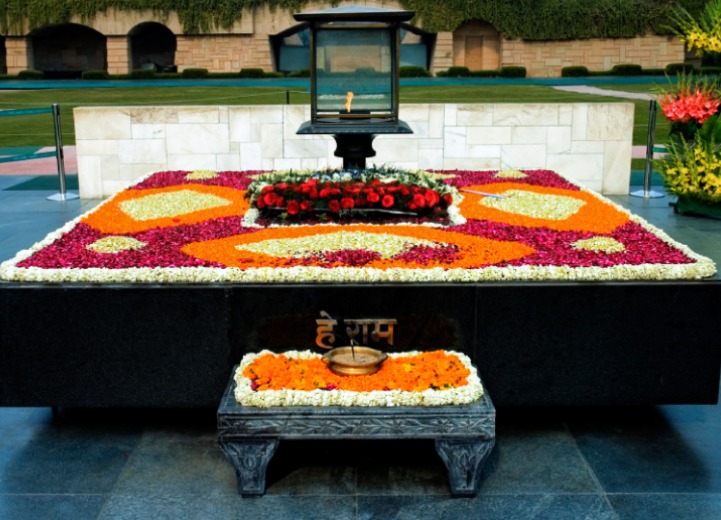
- The Raj Ghat, which is located on the Delhi’s Ring Road, carries a lot of political significance as it is the memorial dedicated to Mahatma Gandhi.
- This is the very site, a shiningly black marble platform, where Gandhiji is cremated. It is an open to the sky platform.
- There is an external flame placed at one end of the platform. The Delhi’s Ring Road is also popularly called the Mahatma Gandhi Road.
- The site features a stoned footpath and on either sides, there are lawns. This footpath takes you to the memorial.
- In addition to the Raj Bhat, you can add several places such as the India Gate, the Lotus Temple, the Red Fort, et al to the bucketlist of tourist destinations in New Delhi.
- The best time to visit the Raj Ghat is during the winter months, as the summers are generally hot and humid in the capital.
- The natural milieu of the Raj Ghat area is also filled with trees planted by public figures and other distinguished personalities.
- Mahatma Gandhi when assassinated on 30th January 1948 was cremated at this place. Previously known as Shajahanabad, a big Ghat of Old Delhi, the memorial was later renamed as the Raj Ghat.
- The Raj Ghat is also resting place of several other leaders including that of Jawaharlal Nehru known as the Shantivan, located to the north of the Raj Ghat, and situated close to it is the cremation site of K R Narayan, the 10th president of India, called Ekta Sthal.
- Alick Percy-Lancaster, who was the Superintendent of Horticultural Operations, GOI, undertook the landscaping of the area. Interestingly, he was the last Britisher to occupy this post.
How has COVID-19 changed religious travel and pilgrimages? – Part 2
Prior to the deadliest pandemic since the new millennium viz. the COVID-19, religious and pilgrimage travel was business big time predicted only to get bigger and better by travel industry pundits. But a storm of change hurled things off the root, and proved all industry prophecies wrong. Just before the pandemic outbreak, an estimated 600 million religious and spiritual voyages were recorded, with 40 per cent of it taking place in Europe and over half of it in different regions of Asia, whilst the annual pilgrimage to Karbala in Iraq, one of the most sacred sites for Muslims after Mecca and Medina and Jerusalem, pulled in over 25 million pilgrims.

Saudi Arabia was not without hope for the annual Hajj this year. The Hajj and Umrah pilgrimages contribute a staggering $12 billion to the Saudi economy under normal circumstances, and this is equal to 20 per cent of the country’s non-oil GDP and 7 per cent of the kingdom’s overall GDP. It is expected that the Hajj and Umrah revenue generated will hit $150bn by 2022. It started on a positive note by enhancing the travel experience for both pilgrims as well as international tourists by pumping money into transport and luxury hotels. In 2019, 1.8 million pilgrims from around the world completed the annual Hajj, whilst tens of millions arrived for the Umrah.
India, the land of spirituality, home to the greatest religions of the world, where people of diverse religions, communities and race have thrived with a great sense of oneness, pride and unity, had all its temples, churches and mosques closed indefinitely. It should be noted that the famous annual Amarnath Yatra that attracts thousands of Hindu devotees, scheduled to begin on June 23 and end up on August 3, on the day of Shravan Purnima had to be cancelled in an effort to curb the spread of COVID-19 in the region.
The health concerns everywhere in the world, as seen above, clearly outweigh the prospects of travelling to pilgrimage sites in the immediate future.
How has COVID-19 changed religious travel and pilgrimages? – Part 1
The spiralling effects of COVID-19 is gathering more moss as religious travel and annual pilgrimages to the holy sites of the country is severely hit with uncertainty over when it will jump back. Though the Central Government had relaxed restrictions following several months of pandemic outbreak since March early this year, the prevailing fear-stricken environment can only push things further back until the start of the next year, as most travel industry experts put it.

Generally mass gatherings, as we all know, in religious sites is the reason attributed to the spread of infection, and this in turn has led to almost zero travel and hotels bookings even after the relaxation of lockdown restrictions in many parts of India. COVID cases in Amristar, and closure of the Shirdi, Vaishno Devi and Tirupati temples made only matters worse. Friday prayers were called off at the Bada Imambadi in Lucknow. Even the gods have remained inaccessible for most part of the time during the lockdown. Hotel bookings and room night in several pilgrimage sites have seen an acute fall in the bookings with travellers putting off travel plans indefinitely, said hotels, OTAs and tour operators. Though the decision to close down pilgrimage sites is viewed as a welcome decision, travel and tour operators may know that they cannot be closed indefinitely. Just for the numbers, there was an aggregate decline of 80 percent in hotel bookings and room nights at pilgrimage sites between the months of January and February this year.
PayTM has stated that the company has witnessed an unprecedented 30 per cent drop in travellers touring the top ten pilgrimage sites in the country. All said and done pilgrimages to the holy sites of the world will see a fundamental change in how it is being conducted in the near future.
How has COVID-19 changed Business or Corporate Travel?- Part 3
The third part of the blog gets more interesting as we discuss another key parameter that will have a huge bearing on the how business or corporate travel will be conducted in the near future. Did we mention safety hygiene? Hygiene, both personal and communal, and in everything we do, has turned out to be a life-saving virtue throughout the pandemic, in addition to maintaining social distancing and equipping ourselves with a proper safety gear. Not surprisingly, customers will display a greater sense of loyalty towards hotel and restaurant brands that practise hygiene religiously, in line with the already existing safety standards and protocols.

Duty-of-care policy:
Now, if you are a corporate or business travel manager, you are in for a spot of bother. The duty-of-care policy adopted by a company is traditionally a documentation of the safety protocols required to protect the welfare and well-being of the employees and staff during business travel. The company has a moral responsibility to safeguard their employees against COVID-19 and other impending virus infections in the future via the duty-of-care policy, and more importantly ensure the employees are fully compliant with the guidelines prescribed.
The travel manager, therefore, has to ensure that majorly hygiene does the talking in the selection of travel vendors including hotels, restaurants , cabs, etc. No longer will cost control alone dictate terms in the selection criteria, but also safety, in addition to other factors such as risk assessment and compliance. It goes without saying that traveller safety, along with comfort, can directly impact productivity at the end of the day. This also includes avoiding travelling in jam-packed planes and overcrowded airports. The firm should also guarantee medical response and security of the employee in the wake of an emergency, well aware of the potential risks. All said and done these are tough times if you are a business owner, and both caution and care must be exercised in order to protect the safety interests of your travelling employees.
Tourism sector is key to revival of Indian Economy: From the founder’s desk – Part 1
Someone asked me the other day if travel is really that important when people are literally scared to venture outside of their homes. The argument basically revolved around the point that key industrial sectors including manufacturing, construction, education and agriculture are awaiting impatiently for a revival of sorts so as to stabilize the economy. But the fact remains that the travel and tourism sector which has contributed substantially to the country’s GDP and job generation cannot be easily discounted. Just for the numbers, the tourism value chain contributes upwards of 9 per cent to the country’s GDP. For a $3 trillion economy, it accounts for a massive $270 billion. The numbers can be higher if we include the demand for food and beverage, fuel as well as how the manufacturing (auto and aviation) and services (construction, real estate and logistics) are impacted. A fourth of this can be stripped of if we fail to implement the right steps now. For instance, almost 12 per cent of Kerala’s GDP is through tourism revenue. A dozen states in India depend largely on tourist cash.

I do agree that people simply don’t have the cover to spend on travel and luxury, but if you take the broader spectrum of things, the time is ripe to restart tourism, given its compound effect on the jobs, economy and people, both psychologically and socially.
If people decide to take short vacations, they can break the ominously threatening viral chains on the economy, serving as the vehicles of growth for the post COVID-19 pandemic recovery phase. If physical barriers are traversed, they can undo restrictions on the movement of labour. This can revitalize factories, considered imperative in the fight against the virus. More on this in the subsequent blog.
Health safety protocols for Tour Operators
A growing travel trend that is fast catching up post-COVI9-19 is private trips and hotel stay and experience that puts isolation above everything else. For those who cannot afford to buy such experiences, travel and tour operators are coming up with novel ways, in addition to the usual social distancing and advanced cleaning and hygiene procedures, that are actually much safer than you imagine. This said it is important that guests, suppliers and staff follow the strict guidelines and modalities as laid down in the COVID-19 safety guidelines.
Group travel when done right actually offers travellers with their own bubble, where they can relax and leave the rest to their guide. Emperor Traveline is a trusted travel brand, and that is the biggest advantage in this new world gripped by the COVID-19 marked by stringent safety and hygiene standards. We offer great assurance for our customers and the pandemic proved to be an opportunity to differentiate ourselves from the rest. We have also developed COVID-19 health and sanitizing guidelines to show that we are compliant.
Guidelines are in place for social distancing, staff training on sanitization and the use of hand sanitizer and masks by guests and staff. We also oversee the safety and health practises of restaurants, hotels and other suppliers to assure our customers that they are fully compliant with the protocols and all local health regulations. We developed these guidelines in collaboration with member companies and build upon our resources and standards from the WHO, IMRC, CDC and protocols of the state government.
We have had an open eyes and ears to the growing concerns of our customers on the health and safety guidelines for tour and travel post-pandemic. With the support of our member organizations and partners, we ensure our customers a safe and secure travel in compliance with the safety policies and all local health rules.
