
All about the Ambalapuzha Sree Krishna Temple in Alleppey
- The Ambalapuzha Sree Krishna Temple is a Hindu Temple believed to have been constructed by the local ruler Chembakassery Pooradam Thirunal-Devanarayanan Thampuran (Alleppey) between the 15th and 17th centuries AD in Alappuzha (Alleppey).

- The temple is linked to the famous Sri Krishna Temple in Guruvayoor. The idol of the temple is held sacred on a par with Parthasarthi that is posing with a whip in the right hand and a sacred Shanku (conch) in the other hand.
- The Palpayasa Nedyam or Payasam, in the form of a sweet pudding prepared of rice and milk, served in this temple is delectable and highly popular amongst devotees. Legend has it that Lord Guruvayoorappan himself visits this temple everyday to have Payasam.
- It is widely believed by the locals that Lord Krishna showed up in the form of a sage and played chess with the king, a chess enthusiast, who ruled that time. The king was challenged by the sage to offer him a grain of rice if he emerges victorious, with the condition that each square would double the grain of rice. The king having lost the game was happy to donate the grain of rice but he soon realized this vicious game of doubling the grain of rice on each square as he ran short of the food grain stock. However Lord Krishna, benevolent in his name, grants him a favour to pay him in part and serve paal payasam until and unless he clears his debt.
- Adopting Kerala style architecture, the temple boasts of a splendid construction displaying a beautiful painting of different avatars of Lord Vishnu in its premises, a centre-piece of attraction.
- Most of all, Ambalapuzha Sri Krishna Temple is notoriously famous for its magical acts and the annual Ottanthullal ritual.
- The main festival of this shrine is Chambakulam Moolam celebrated on the Moolam Day every year. This place is always buzzing with pilgrims and tourists to receive the blessings from Lord Krishna. The popular Aaraattu festival during the months of March and April begins with the flag hoisting on the Atham star. Pallipana is celebrated in the temple once in every 12 years.
All about the Albert Hall Museum in Jaipur
- The beauty of Jaipur in Rajasthan, as a tourist destination, is simply unrivalled. The best way to study the culture of a region is to visit the local museum. The Albert Hall Museum in Jaipur serves as the gateway to learning the cultural traditions and various art forms of the “Pink city”.

- Built in 1876, first as a concert hall and later as Town hall in 1880, the Albert Hall got its name from London’s Victoria and Albert Museum because of its strikingly similar architecture. The building’s foundation was laid out in 1876, when the Prince of Wales visited the city.
- It was Maharaja Sawai Madho Singh II, the ruler of Jaipur, who suggested that Albert Hall be used as a museum for industrial arts.
- The hall was later used for exhibiting masterpieces of local craftsmen and artisans. The museum, by 1881, was opened to public that even bought artwork, handicrafts and other masterpieces on display. However, the museum wasn’t fully constructed until 1887. Later, valuable antiques were added to the modern artefacts collection.
- The architecture of the building is Indo-Saracenic in style and holds unique stone ornamentation. The museum’s corridors stock Persian paintings, mural paintings, among others. The murals on view vividly express the ancient civilizations of Babylonians, Chinese, Greek and others.
- The museum houses 16 galleries in total that display a spectacular collection of antiques, artefacts and artworks in the following categories: Arms & Armour, Pottery, Sculptures, Miniature Paintings, Clay Works, Marble Art, International Art, Ivory, Jewellery, Woodwork & Furniture, Coins, Musical Instruments, Garments, Carpet, and other miscellaneous collections. In addition to these, there is an exclusive ‘gallery of the month’ which displays unique collections.
- The museum, which is open from 9AM to 5PM on all days, is well connected with all the other parts of the city. Located nearby the Merta Road Junction Railway Station, the Albert Hall Museum can be reached via local train, cab or public transportation.
Things to know about the famous Naulakha Bazaar in Agra
- The city of Agra in Uttar Pradesh is a potpourri of the diverse Indo-Islamic culture, whilst also conforming to the modern society. While there are several places to explore in Agra, the Naulakha Bazaar, meaning ‘a market worth nine lakhs’ in English, offers a wholesome shopping experience for Indian fashion and food lovers.

- This ever-bustling bazaar is located near Sadar Bazaar, another popular marketplace in Agra. Though tourists gather in large numbers in Naulakha Bazaar, its streets and bylanes are quite narrow like Delhi’s Chandni Chowk, so typical of Indian Bazaars.
- The market’s speciality items include a range of imitation jewellery and ornamental showpieces which you can find in Loha Mandi, an area located within the Naulakha Bazaar. In addition to metal goods, you can find a number of shops that specialize in ethnic wear manufactured locally in Uttar Pradesh.
- The Naulakha Bazaar is also popular for items made of timber. Besides, the local people purchase sundry items such as stationary and toys here.
- Buying cosmetics in the market would require careful consideration, as most items are either fake or counterfeit of popular international brands. Because these cosmetics contain toxic chemicals, they can easily harm the skin. Shoppers here also look for sport shoes, mojris and leather slippers and sandals that come in attractive designs for all ages.
- Bargaining for the right price is very much important at Naulakha Bazaar, which remains crowded from late morning hours (later than 10am) to even midnight during festival and peak season times.
- The mouth-watering local street foods including chats, milkshakes, desserts, kebabs, et al are guaranteed to satiate your hunger pangs after you’re done wandering the narrow lanes of the bazaar.
- The Naulakha Bazaar overall is a true reflection of the rich local culture and traditions of the city. Visiting the market can be an amazing experience, rest assured never to leave you disappointed.
All about the Birla Mandir in Hyderabad
- Birla Mandir is a gleaming white structure adorning the skyline of the city of Hyderabad
- It is located to the south of Hussain Sagar Lake in Hyderabad, atop the Kala Pahar, a twin hummock of Naubath Pahad.

- Birla Mandir, situated at a height of 280-feet above sea level, was built by the Birlas in 1976 on a 13-acre land; the glistening white marbles used in the construction of the temple were sourced from Rajasthan.
- The construction, which took nearly a decade to complete, was later sanctified by Swami Ranganathanda, a Hindu swami of the Ramakrishna Math order. There are similar temples constructed all across the country by the Birla Foundation, patron of Birla Temple at Hyderabad too.
- The main deity of the temple is Lord Vishnu or Sri Venkateswara, made of granite, and is 11-feet tall. The temple plays kirtanas of Annamayya, Tyagaraja and Ramadasu every day bringing in a strong spiritual vibration.
- The temple’s architectural style is a combination of South Indian and Utkal (Oriya): the main shrine also known as the Jagadananda Vimanam depicts the Oriyan style, whilst the Rajagopuram is reflective of the South Indian architectural style.
- The two great Indian epics of Ramayana and Mahabharata are depicted in the intricately carved marbles. The design of Garbha Gudi (sanctum sanctorum) which is 42-feet high was inspired by the world-famous Venkateshwara temple at Tirumala.
- The temple has separate shrines for the consorts of Swami Venkateswara: Padmavati and Andal. Interestingly, the Birla Mandir complex is also built with a temple dedicated to Lord Buddha, with his life events portrayed through fresco paintings. The temple complex also houses separate shrines for worshipping other Hindu gods including Hanuman, Ganesh, Shiva, Brahma, Saraswati and Saibaba.
- Birla Mandir, which is open from 7AM -12AM and 3PM – 9PM on weekdays and weekend respectively, is a truly spectacular sight when illuminated at night
- The temple is highly accessible from all parts of the city, thanks to the State transportation facilities. You can take a bus, and get down near Ravindra Bharathi, which is only 200m away from the temple.
All about the Devil’s Kitchen in Kodaikanal
What is the first thing that comes to your mind when you listen to the popular Tamil tune “Kanmani Anbodu Kadhalan” from the Kamal Hasan starrer movie “Guna”?
What is the first thing that comes to your mind when you listen to the popular Tamil tune “Kanmani Anbodu Kadhalan” from the Kamal Hasan starrer movie “Guna”? The natural yet mysterious Guna cave derives its name from the psychological romance movie shot in 1992. Here are a few interesting points on the Devil’s Kitchen in Kodaikanal:

- The Guna cave is also known as the “Devil’s Kitchen”, and is located on the outskirts of the hill station of Kodaikanal which is accessible from the Moir Point.
- The place got raving popularity after the success of the movie “Guna” as more tourists started visiting the cave to catch a glimpse of the massive, pillar-shaped rocks.
- Frequented only by hikers before the movie was shot, the Guna cave has a group of caverns located amidst the three massive boulders called Pillar Rocks.
- The gorge is immersed in the thick low clouds during the monsoon and winter seasons. The main entrance of the cave is separated from the hill top by about 400 metres.
- Guna caves, one of the highly visited tourist places today, was first discovered by B.S. Ward, an English Officer, in 1821. The caves are located at an altitude of 2230 metres above sea level.
- The distance between Guna caves and Kodaikanal Bus Station is 8.5km. You need to walk about 1.5 km from the Pillar rock to reach Guna Caves.
- Walk through a delightful pine forest with the roots of the trees emerging onto the surface, lending an eerie look to the place.
- The site also has historical significance, in addition to being a popular touring destination. You can view the cave from a distance as its surroundings generally remain closed citing security reasons. You can enjoy the beauty of the spot especially if the sun is out and shining.
All about the Chhatrapati Shivaji Maharaj Vastu Sangrahalaya in Mumbai
- The Chhatrapati Shivaji Maharaj Vastu Sangrahalaya (CSMVS) is one of the important arts and cultural museums in Mumbai in the state of Maharashtra.

- This museum has been preserving some of India’s most treasured historic relics for over a century which makes it a landmark destination for locals and tourists in Mumbai.
- The museum was born after some of the eminent personalities and distinguished citizens of Mumbai decided to build a public museum, first as a memorial, to commemorate the visit of the Prince of Wales (later King George V) in the year 1905
- The building was initially used as a military hospital throughout the First World War. It was opened to public view only in 1922 after being inaugurated by Lady Lloyd, the wife of the then Governor of Bombay.
- The design of the museum is a combination of Saracenic and Indian architectural forms. It was George Wittet, the famous Scottish architect known for his design of the Gateway of India, who designed the museum.
- It is said that he was inspired by the building design of the Gol Gumbaz in Bijapur and the Taj Mahal in Agra.
- The museum’s wide range of collection has archaeological artefacts and finds of the rich civilization and cultural values of the Indian subcontinent the Indus Valley Civilization, the Mughal rule and the Marathas among others.
- The museum’s different galleries include cultural aspects of Nepal-Tibet, natural history, European history, etc. The arms and armour galley has the private armour of the Mughal ruler Akbar.
- CSMVS, in collaboration with institutions like the Jehangir Art Gallery, has immensely contributed to the advancement of the neighbourhood of Kala Ghoda as a place for artistic studies.
- It actively hosts many public programs such as seminars, workshops and documentary film screenings for students and general public.
- The museum even conducts post-graduate diploma courses in heritage studies and conservation and museology and conservation.
Interesting facts on the Droog Fort in Coonoor
- One of the most popular tourist destinations in Coonoor in Tamilnadu, Droog Fort is a ravishing beauty of a place with its stunning backdrop, guaranteed to attract tourists in large numbers during the peak seasons of the year.

- Surrounded by the jaw-dropping view of the Western Ghats, the fort, some 30 kms away from Nilgiris, the Queen of hill stations, is a delight whether you’re a history lover or solitary wanderer or an amateur bird watcher as this area is a natural habitat for exotic varieties of bird species and animals including flying foxes and few Malabar squirrels.
- Alternately known as Bakasural Malai due to the legend of a demon residing at the fort several centuries ago, this 18-th century fort is located at an altitude of 6000 ft above the sea level.
- It is widely believed by local historians that the famous Mysore ruler Tipu Sultan used the Droog Fort to monitor the day-to-day activities of the neighbouring rulers and their kingdoms.
- Therefore, this fort is strategically built for carrying out military activities in the bordering areas, in addition to sharing vital communication on planned and on-going military activities in and around these areas.
- The Droog Fort offers a panoramic view from the watchtower, and is known to have hidden tunnels for the safety and protection of kings from foes during surprise attacks in the case of a siege. The fort also has a sole wall which is another attraction for tourists here.
- Filled with the minty scent of eucalyptus and the strong aroma of coffee, this place is frequented by bisons and other wild animals especially at night. Therefore, you need to be extremely careful while making a trip to the fort.
- Nearby attractions include the Nonsuch tea estate through which you can walk your way up the fort, Law falls, a scenic cascade waterfall of the hill station.
When have you planned to visit Amer or Amber Fort in Rajasthan?
- A 16-th century fort, it was raised by Maan Singh, a trusted general of the Mughal Emperor Akbar.
- The Amer or Amber Fort is located in the city of Amber, situated at a distance of 11km from the capital city of Jaipur in the state of Rajasthan.
- Amer was later ruled by Maan Singh, according to a decree by Akbar. Amber Fort today is one of the major tourist destinations of the state.

Places to visit in Amer Fort:
- Diwan-e-Aam or Hall of public audience is a grand hall that is supported by two rows of pillars, each of which is delicately ornamented. This hall, a major attraction for its mosaic work, is open on three sides.
- Sheesh Mahal or the Mirror Palace, built for the queen of the fort, is marked by grandeur. This palace is the shooting spot for many Bollywood movies. The ceilings and walls in this palace are beautifully carved with intricate flowers and fine glass paintings.
- The Mughal Gardens or Kesar Kyaari is located on Lake Maota on front of the Amer Fort. Shaped like a star, the garden is said to have been planted with saffron flowers, though climatic conditions aren’t actually conducive to growing saffron flowers.
- A special light show on the history of Jaipur city and the Amer fort is conducted every evening. A 50-min video in both English and Hindi, it throws light on the sovereigns, historical significance of the palace, and other details.
- SukhNiwaas or SukhMandir or residence of pleasure is a hall made with ivory and sandalwood. Situated straight opposite to the Diwan-e-Aam, you will find a small channel carrying cold water, a traditional method that helps keep the place cool. Interestingly, it is not a temple, but a relaxation place for kings and queens.
Things to do: Elephant ride around the fort; night-time Light Show; panoramic view of the entire city from Char garden; classical dance program; enjoying traditional songs and puppet shows of local artists; visiting a unique Turban museum; visiting the Siladevi temple; savouring a meal at Surabhi restaurant; watching the brightly illuminated fort from the foot of the hill when the sun is down.
Interesting facts on the Raj Ghat in New Delhi
This week let’s check out an important political centre, though a lesser known tourist place, in New Delhi namely the Raj Ghat.
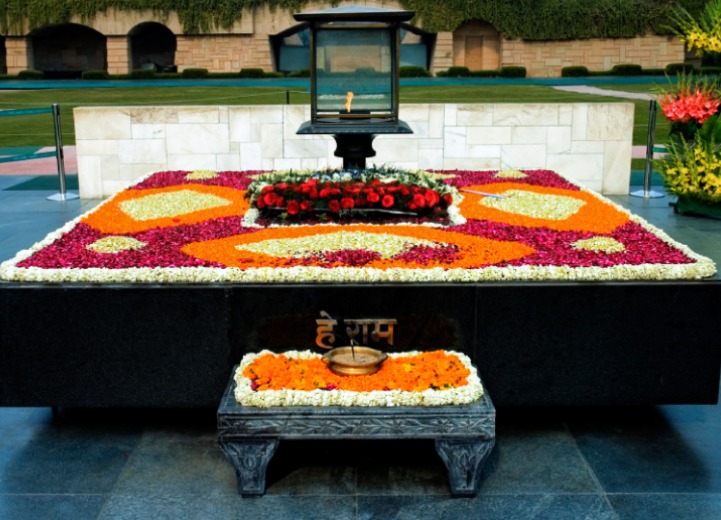
- The Raj Ghat, which is located on the Delhi’s Ring Road, carries a lot of political significance as it is the memorial dedicated to Mahatma Gandhi.
- This is the very site, a shiningly black marble platform, where Gandhiji is cremated. It is an open to the sky platform.
- There is an external flame placed at one end of the platform. The Delhi’s Ring Road is also popularly called the Mahatma Gandhi Road.
- The site features a stoned footpath and on either sides, there are lawns. This footpath takes you to the memorial.
- In addition to the Raj Bhat, you can add several places such as the India Gate, the Lotus Temple, the Red Fort, et al to the bucketlist of tourist destinations in New Delhi.
- The best time to visit the Raj Ghat is during the winter months, as the summers are generally hot and humid in the capital.
- The natural milieu of the Raj Ghat area is also filled with trees planted by public figures and other distinguished personalities.
- Mahatma Gandhi when assassinated on 30th January 1948 was cremated at this place. Previously known as Shajahanabad, a big Ghat of Old Delhi, the memorial was later renamed as the Raj Ghat.
- The Raj Ghat is also resting place of several other leaders including that of Jawaharlal Nehru known as the Shantivan, located to the north of the Raj Ghat, and situated close to it is the cremation site of K R Narayan, the 10th president of India, called Ekta Sthal.
- Alick Percy-Lancaster, who was the Superintendent of Horticultural Operations, GOI, undertook the landscaping of the area. Interestingly, he was the last Britisher to occupy this post.
All about the famous Diwan-i-Khas in Fatehpur Sikri
- Diwan-i-Khas, or more popularly known as the Hall of Private Audience, is located in the northeast corner of the royal complex, constructed with a massive and splendidly carved pillar in the centre.
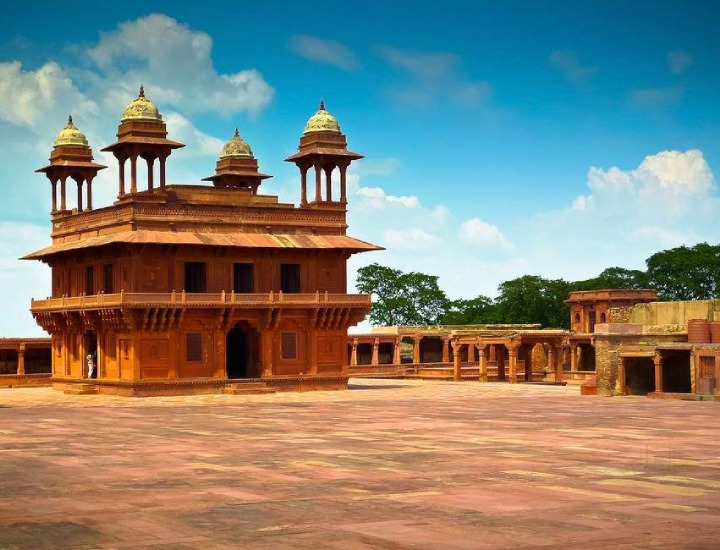
- There is a central platform that is attached to the pillar. This is believed by many to be the seat of the powerful Mughal emperor with the diagonal galleries the seat of the nobles and ministers entertained in the court.
- However, there are others who believed that because the galleries were too narrow to house all the courtesans and ministers at once, the building actually served as the storehouse for the valuable treasures of the royalty including gems and jewels that were inspected by the Emperor himself.
- According to the historian Abul Fazl, the Mughal ruler Akbar had three treasuries located close to each other and only one among them was used to store the priceless possessions.
- As this building is nearby the ‘Ankh Michauli’ or the storehouse of gold and silver, it is widely believed to be the treasury for jewels.
- There are four double-storeyed facades in this square red sand stone structure. You will find no huge dome or superstructure here typical of Islamic architecture but four impressive kiosks at every corner of the building that are octagonal-shaped, crowned by a circular dome with an inverted lotus mounted on the top elevating the overall height of the structure.
- The interior arrangements are unique in design. The main hall comprises an elegantly designed capital constructed by linking 36 brackets emerging from the pillars in three tiers that are circularly shaped. The building isn’t known for ornamentation unlike other Islamic architecture around the world. However, the imposing situated in the centre is definitely one of the towering examples of the Mughal architecture.
