
All about the Devil’s Kitchen in Kodaikanal
What is the first thing that comes to your mind when you listen to the popular Tamil tune “Kanmani Anbodu Kadhalan” from the Kamal Hasan starrer movie “Guna”?
What is the first thing that comes to your mind when you listen to the popular Tamil tune “Kanmani Anbodu Kadhalan” from the Kamal Hasan starrer movie “Guna”? The natural yet mysterious Guna cave derives its name from the psychological romance movie shot in 1992. Here are a few interesting points on the Devil’s Kitchen in Kodaikanal:

- The Guna cave is also known as the “Devil’s Kitchen”, and is located on the outskirts of the hill station of Kodaikanal which is accessible from the Moir Point.
- The place got raving popularity after the success of the movie “Guna” as more tourists started visiting the cave to catch a glimpse of the massive, pillar-shaped rocks.
- Frequented only by hikers before the movie was shot, the Guna cave has a group of caverns located amidst the three massive boulders called Pillar Rocks.
- The gorge is immersed in the thick low clouds during the monsoon and winter seasons. The main entrance of the cave is separated from the hill top by about 400 metres.
- Guna caves, one of the highly visited tourist places today, was first discovered by B.S. Ward, an English Officer, in 1821. The caves are located at an altitude of 2230 metres above sea level.
- The distance between Guna caves and Kodaikanal Bus Station is 8.5km. You need to walk about 1.5 km from the Pillar rock to reach Guna Caves.
- Walk through a delightful pine forest with the roots of the trees emerging onto the surface, lending an eerie look to the place.
- The site also has historical significance, in addition to being a popular touring destination. You can view the cave from a distance as its surroundings generally remain closed citing security reasons. You can enjoy the beauty of the spot especially if the sun is out and shining.
All about the Chhatrapati Shivaji Maharaj Vastu Sangrahalaya in Mumbai
- The Chhatrapati Shivaji Maharaj Vastu Sangrahalaya (CSMVS) is one of the important arts and cultural museums in Mumbai in the state of Maharashtra.

- This museum has been preserving some of India’s most treasured historic relics for over a century which makes it a landmark destination for locals and tourists in Mumbai.
- The museum was born after some of the eminent personalities and distinguished citizens of Mumbai decided to build a public museum, first as a memorial, to commemorate the visit of the Prince of Wales (later King George V) in the year 1905
- The building was initially used as a military hospital throughout the First World War. It was opened to public view only in 1922 after being inaugurated by Lady Lloyd, the wife of the then Governor of Bombay.
- The design of the museum is a combination of Saracenic and Indian architectural forms. It was George Wittet, the famous Scottish architect known for his design of the Gateway of India, who designed the museum.
- It is said that he was inspired by the building design of the Gol Gumbaz in Bijapur and the Taj Mahal in Agra.
- The museum’s wide range of collection has archaeological artefacts and finds of the rich civilization and cultural values of the Indian subcontinent the Indus Valley Civilization, the Mughal rule and the Marathas among others.
- The museum’s different galleries include cultural aspects of Nepal-Tibet, natural history, European history, etc. The arms and armour galley has the private armour of the Mughal ruler Akbar.
- CSMVS, in collaboration with institutions like the Jehangir Art Gallery, has immensely contributed to the advancement of the neighbourhood of Kala Ghoda as a place for artistic studies.
- It actively hosts many public programs such as seminars, workshops and documentary film screenings for students and general public.
- The museum even conducts post-graduate diploma courses in heritage studies and conservation and museology and conservation.
Interesting facts on the Droog Fort in Coonoor
- One of the most popular tourist destinations in Coonoor in Tamilnadu, Droog Fort is a ravishing beauty of a place with its stunning backdrop, guaranteed to attract tourists in large numbers during the peak seasons of the year.

- Surrounded by the jaw-dropping view of the Western Ghats, the fort, some 30 kms away from Nilgiris, the Queen of hill stations, is a delight whether you’re a history lover or solitary wanderer or an amateur bird watcher as this area is a natural habitat for exotic varieties of bird species and animals including flying foxes and few Malabar squirrels.
- Alternately known as Bakasural Malai due to the legend of a demon residing at the fort several centuries ago, this 18-th century fort is located at an altitude of 6000 ft above the sea level.
- It is widely believed by local historians that the famous Mysore ruler Tipu Sultan used the Droog Fort to monitor the day-to-day activities of the neighbouring rulers and their kingdoms.
- Therefore, this fort is strategically built for carrying out military activities in the bordering areas, in addition to sharing vital communication on planned and on-going military activities in and around these areas.
- The Droog Fort offers a panoramic view from the watchtower, and is known to have hidden tunnels for the safety and protection of kings from foes during surprise attacks in the case of a siege. The fort also has a sole wall which is another attraction for tourists here.
- Filled with the minty scent of eucalyptus and the strong aroma of coffee, this place is frequented by bisons and other wild animals especially at night. Therefore, you need to be extremely careful while making a trip to the fort.
- Nearby attractions include the Nonsuch tea estate through which you can walk your way up the fort, Law falls, a scenic cascade waterfall of the hill station.
When have you planned to visit Amer or Amber Fort in Rajasthan?
- A 16-th century fort, it was raised by Maan Singh, a trusted general of the Mughal Emperor Akbar.
- The Amer or Amber Fort is located in the city of Amber, situated at a distance of 11km from the capital city of Jaipur in the state of Rajasthan.
- Amer was later ruled by Maan Singh, according to a decree by Akbar. Amber Fort today is one of the major tourist destinations of the state.

Places to visit in Amer Fort:
- Diwan-e-Aam or Hall of public audience is a grand hall that is supported by two rows of pillars, each of which is delicately ornamented. This hall, a major attraction for its mosaic work, is open on three sides.
- Sheesh Mahal or the Mirror Palace, built for the queen of the fort, is marked by grandeur. This palace is the shooting spot for many Bollywood movies. The ceilings and walls in this palace are beautifully carved with intricate flowers and fine glass paintings.
- The Mughal Gardens or Kesar Kyaari is located on Lake Maota on front of the Amer Fort. Shaped like a star, the garden is said to have been planted with saffron flowers, though climatic conditions aren’t actually conducive to growing saffron flowers.
- A special light show on the history of Jaipur city and the Amer fort is conducted every evening. A 50-min video in both English and Hindi, it throws light on the sovereigns, historical significance of the palace, and other details.
- SukhNiwaas or SukhMandir or residence of pleasure is a hall made with ivory and sandalwood. Situated straight opposite to the Diwan-e-Aam, you will find a small channel carrying cold water, a traditional method that helps keep the place cool. Interestingly, it is not a temple, but a relaxation place for kings and queens.
Things to do: Elephant ride around the fort; night-time Light Show; panoramic view of the entire city from Char garden; classical dance program; enjoying traditional songs and puppet shows of local artists; visiting a unique Turban museum; visiting the Siladevi temple; savouring a meal at Surabhi restaurant; watching the brightly illuminated fort from the foot of the hill when the sun is down.
Interesting facts on the Raj Ghat in New Delhi
This week let’s check out an important political centre, though a lesser known tourist place, in New Delhi namely the Raj Ghat.
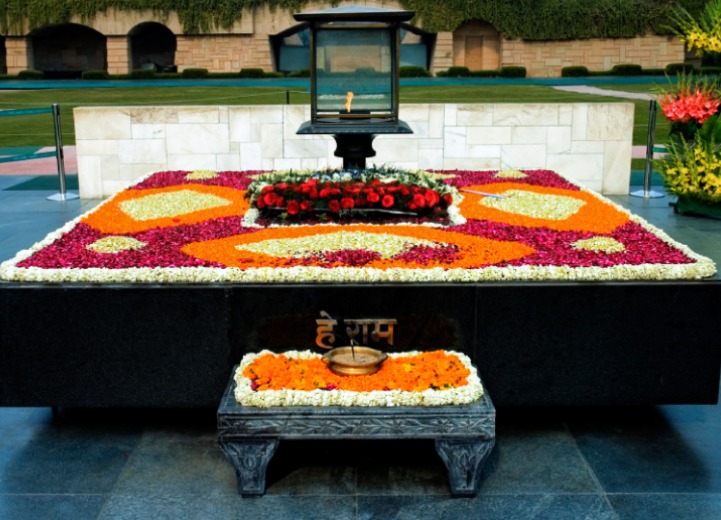
- The Raj Ghat, which is located on the Delhi’s Ring Road, carries a lot of political significance as it is the memorial dedicated to Mahatma Gandhi.
- This is the very site, a shiningly black marble platform, where Gandhiji is cremated. It is an open to the sky platform.
- There is an external flame placed at one end of the platform. The Delhi’s Ring Road is also popularly called the Mahatma Gandhi Road.
- The site features a stoned footpath and on either sides, there are lawns. This footpath takes you to the memorial.
- In addition to the Raj Bhat, you can add several places such as the India Gate, the Lotus Temple, the Red Fort, et al to the bucketlist of tourist destinations in New Delhi.
- The best time to visit the Raj Ghat is during the winter months, as the summers are generally hot and humid in the capital.
- The natural milieu of the Raj Ghat area is also filled with trees planted by public figures and other distinguished personalities.
- Mahatma Gandhi when assassinated on 30th January 1948 was cremated at this place. Previously known as Shajahanabad, a big Ghat of Old Delhi, the memorial was later renamed as the Raj Ghat.
- The Raj Ghat is also resting place of several other leaders including that of Jawaharlal Nehru known as the Shantivan, located to the north of the Raj Ghat, and situated close to it is the cremation site of K R Narayan, the 10th president of India, called Ekta Sthal.
- Alick Percy-Lancaster, who was the Superintendent of Horticultural Operations, GOI, undertook the landscaping of the area. Interestingly, he was the last Britisher to occupy this post.
All about the famous Diwan-i-Khas in Fatehpur Sikri
- Diwan-i-Khas, or more popularly known as the Hall of Private Audience, is located in the northeast corner of the royal complex, constructed with a massive and splendidly carved pillar in the centre.
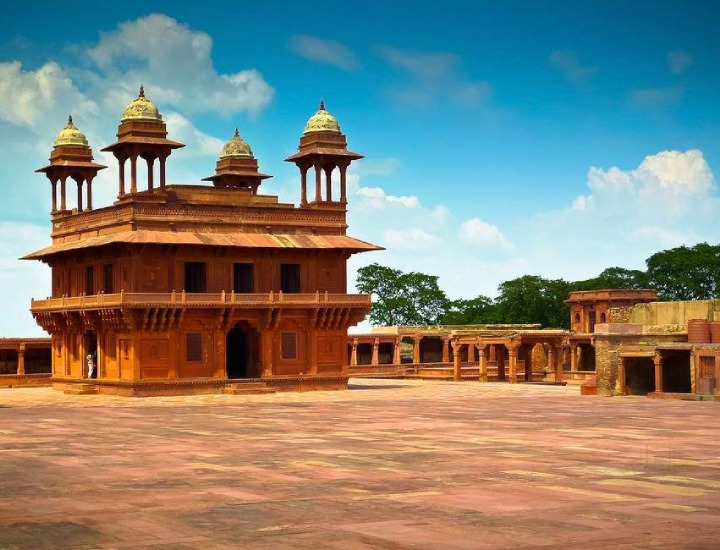
- There is a central platform that is attached to the pillar. This is believed by many to be the seat of the powerful Mughal emperor with the diagonal galleries the seat of the nobles and ministers entertained in the court.
- However, there are others who believed that because the galleries were too narrow to house all the courtesans and ministers at once, the building actually served as the storehouse for the valuable treasures of the royalty including gems and jewels that were inspected by the Emperor himself.
- According to the historian Abul Fazl, the Mughal ruler Akbar had three treasuries located close to each other and only one among them was used to store the priceless possessions.
- As this building is nearby the ‘Ankh Michauli’ or the storehouse of gold and silver, it is widely believed to be the treasury for jewels.
- There are four double-storeyed facades in this square red sand stone structure. You will find no huge dome or superstructure here typical of Islamic architecture but four impressive kiosks at every corner of the building that are octagonal-shaped, crowned by a circular dome with an inverted lotus mounted on the top elevating the overall height of the structure.
- The interior arrangements are unique in design. The main hall comprises an elegantly designed capital constructed by linking 36 brackets emerging from the pillars in three tiers that are circularly shaped. The building isn’t known for ornamentation unlike other Islamic architecture around the world. However, the imposing situated in the centre is definitely one of the towering examples of the Mughal architecture.
All about the Fort Aguada – the Fortress of Strength
- Goa, the smallest state in India in terms of area and word length, synonymous for the spectacular beaches, stunning parties and ultra modernity has lot more to offer in terms of heritage and culture in addition to its exciting touring destinations popular the world over.

- A stark reflection of the state’s colonial history, the Fort Aguada is built in 1510 after the Portuguese conquered it comprehensively.
- The fort that stands stall is located on the Sinquerim beach at the mouth of the Mandovi River facing the Arabian Sea.
- Built between the years 1609 and 1612, the name of the fort comes from ‘agua’ meaning ‘water’. There is a spring within the fort that enabled the crews of passing ship to top up their freshwater sources.
- The fort was bifurcated into two sections: the upper part functioning as a watershed, and a fort well insulated by a deep dry moat. The lower part served as a safe hour for the Portuguese vessels to hoard and top up their supplies, in addition to being a bastion, gun powder room and a clandestine escape passage during emergency.
- Besides the huge cistern of the fort could store up to 2, 30,000 gallons of water. The high fort served as a citadel against invading forces during the Portuguese rule.
- Main attractions of the fort include a four-storey lighthouse, one of the oldest in Asia, which was raised in 1864. However, it has remained out of use since 1976.
- Interestingly, huge bonfires were lit on the ‘Hills of Pilot’ just above the site of the Church of Immaculate Conception in Pune to guide the sailing ships into safety.
- It was under the administration of Antonio de Oliveira that he turned the lower part of the fort into prison, and protestors who demanded that Goa be handed back to India were imprisoned here. Today, it is more popular as Goa’s central jail housing those accused of trafficking and narcotics-related offenses.
- Much of the fort today is acquired by the Taj group of Hotels as a Heritage hotel. Get yourself transported back to the time where the angry waves rolled the ships into its sheltered harbour. Definitely, worth a visit.
Kanakakunnu Palace in Trivandrum, Motley of Heritage and Ecology
- The Kanakakunnu Palace in Trivandrum was once the venue for stately events of the erstwhile royal family of Travancore

- Listed by the Indian National Trust for Art and Cultural Heritage as a heritage monument, the Kanakakunnu Palace in Trivandrum today is motley of history and ecology.
- The palace, constructed during the reign of King Sree Mulam Tirunal (1885-1924), was used for royal banquets. Swati Tirunal gave a complete makeover of the palace, and even built a tennis court on its premises.
- Opened first to public view in the 1960s as a venue for marriages, the splendid edifice, the jewel on the ridge of a hillock laden with landscaped green meadows, bamboo thickets and blossoming shrubs have become a favourite among the locals and tourists. There are many events that are conducted here in its stately halls.
- Members of walking & laughing clubs, yoga practitioners, in addition to college students, nature lovers and senior citizens hang out in large numbers. The rare trees here are another attraction.
- This place is also used to hold government-sponsored events and other cultural events. But the increasing number of commercial activities in and around the building has posed several challenges to the Tourism Department which takes care of it.
- The locals are opposed to the idea of using this place for trade fairs and exhibitions, considering the significance of its cultural, historical and architectural values.
- The significance of the Kanakakunnu Palace is also felt in its role in micro-climate amelioration and regulation and curbing emission of greenhouses gases, as a lush green, open space in the busiest part of the city.
- The meadows in the hill terrain if properly maintained can turn out to be a natural herbal peak with Dasapushpam’s and other precious flora, making it a nature’s herb museum, and for people to just relax and walk, and kids to play on the premises.
- Locals also suggest that it should be made a heritage zone, and that a nominal entry fee can be collected for maintaining the park sublimely green.
All About the Plettenberg Bay in South Africa
The town of Plettenbergy Bay is situated almost on the edge of Eastern and Western Cape. Built on the hillside, most part of the town is located on a steep slope descending all the way into the sea. Once you are at the Plettenbergy Bay, you’ll be treated to the scintillating views of the bay and surrounding mountain ranges and hills. There are a numbers of upmarket resorts and hotels to self catering, to budget Bed & Breakfasts and accommodation here.

The Plettenberg Bay, once a quaint town, was visited by European explorers from Portugal and the UK. The remnants of the Gonzales Wreck in town; Old Rectory, constructed by the Dutch East India Trading Company in 1776 and Forest Hall, a stately home that was privately owned, established in 1864 by William Henry Newdgate stand tall to this day.
Popular tourist activities include yachting at the Keurbooms River mouth and marina and playing polo at Kurland. You can indulge yourself in water sports and swimming in the clear and serene waters. There are many pristine beaches worth a visit, and if you want to boost your adrenaline performance, there are a host of activities including hiking, charter boat cruises, abseiling and canoeing. Another popular attraction is the Monkeyland Primate Sanctuary, a one of its kind multi-species, free roaming primate sanctuary. You can also make a trip to the Witblits distillery and Mampoer.
Don’t go away, there’s lot more: you can take a short trip on the N2 moving towards Port Elizabeth, across the border into the Eastern Cape, and return to the Bloukrans Bridge. An engineering wonder, it is where the world’s highest commercial bungee jump site is located. Situated at 216 metres, it is not for everybody to take a plunge from the purpose-built observing platform bordering the gorge.
If you are done with the above activities, visit the Khoisan Village to take a glimpse of the lives of the indigenous peoples of the area, and enjoy buying local arts and crafts.
Everything you need to know about the Dolmen Circle in Kodaikanal
- Are you burned out and knackered this summer and wanted to take a breather? One of the best places in Tamilnadu to be this summer is the charming hill station of Kodaikanal that has about 40 tourist attractions. One of the lesser known places in Kodaikanal, though popular, is the Dolmen Circle.

- The Dolmen Circle is about 8km from Kodaikanal Lake and 18km from Berijam Lake. It is one of the most important places among anthropologists. A pre-historic site, the Dolmen Circle dates back to 5000 BC.
- This place is believed to be the dwelling place and burial site of the pre-historic man who belonged to the Iron Age and Stone Age. They are known as dolmens and Kistavens.
- Situated nearby the Parvatha Vihar and the Pannikadu village, the dolmen is raised out of two huge erect slabs covered by a huge flat slab.
- The sands of time brought destruction to several dolmens, so only two survive now. One is found at the Ghat Road near Periyakulam and another 2 km away from the hamlet of Pannaikadu.
- It is located on the highest point before you descend to Pattiveerampatti still standing rock-solid without significant damage.
- The place is the remains of pre-historic inhabitants in addition to models of dolmens and burial urns. The ruins and remains of the place can transport you right to the pre-historic living.
- Research also shows that these were used as hideout for the pre-historic man. It is also widely believed that this site served as a safe haven for people to hoard their valuables. Site excavations in the past unearthed several copper and brass ornaments in addition to the utensils. On the other hand, Kistavens were used as burial grounds.
